Acquiring high-authority expired domains is the starting point for creating a successful PBN. Expired domains have solid backlink profiles that can increase your target website's chances of ranking.
However, not all expired domains can give the same value. You need to review their backlink profile and verify whether the domain is spammy or previously penalized. This blog post provides practical steps to identify the right expired domains to strengthen your PBN.
Why are High-Authority Domains Valuable?
Expired domains are previously registered domains whose owners have not renewed them before the expiration date. The registration typically lasts for one year, and when the domain expires, several things can happen. The domain can either be renewed, auctioned, returned to the registry, or set up for domain squatting, which is illegal.
Registrants typically have up to 90 days to renew their domain before it's moved to auction or dropped. If the domain hasn't been auctioned after 75-90 days, it returns to the registry for general sale.
A high-authority expired domain is valuable in a PBN because it passes authority to the linked domain, increasing its chances of ranking.
Also, you can set up a 301 redirect to pass traffic to the main website if the domain was previously a high-traffic site. However, ensure the content on your new website matches that previously hosted on the old domain, so traffic flows align. Plus, 301 redirects don't just pass on traffic. They pass the domain's full authority instantly, like linking does, but it's more effective.
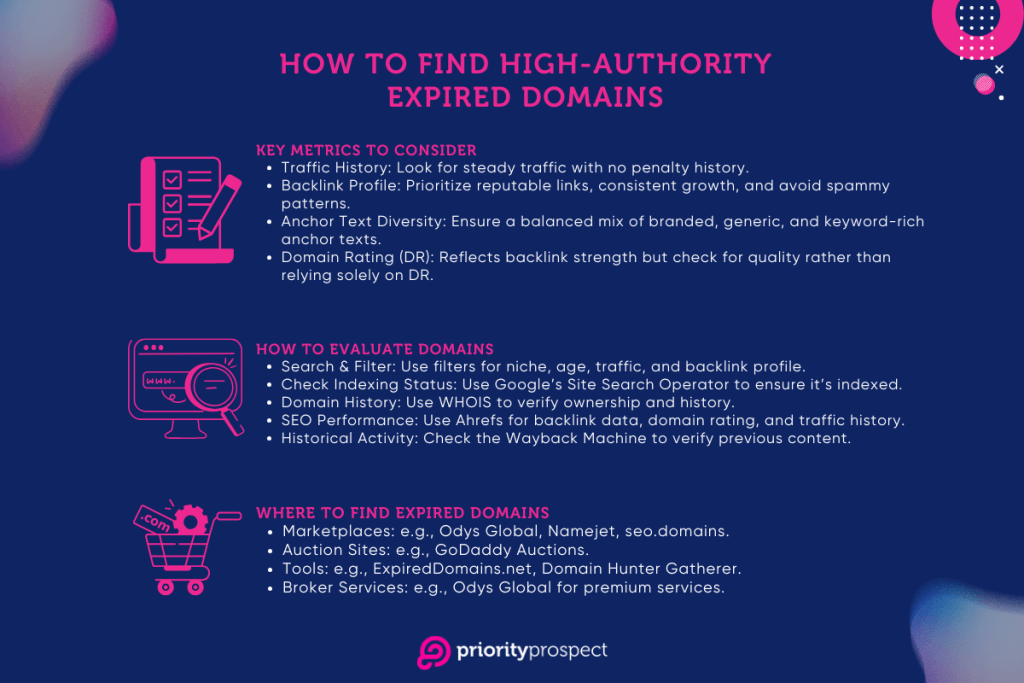
Key Metrics to Consider When Evaluating Expired Domains
When acquiring an expired domain, what key metrics should you use to streamline your search? Let's find out:
Traffic History
The first thing you need to evaluate before buying an expired domain is its traffic history. You need to know whether the domain received consistent traffic or if it lost traffic at any point.
Factors such as algorithm changes, server downtime, and broken links can cause domains to lose traffic, but you need to ensure the sudden loss was not due to penalties.
Backlink Profile
You should also evaluate the backlink profile of an expired domain, as it typically determines the domain's credibility.
Check that the links are from reputable, authoritative websites, and avoid domains with spammy backlinks. Also, check whether the domain has consistently built links over time. Any unusual spike in backlinks may suggest manipulation and could result in penalties over time.
Anchor Text Distribution
A good backlink profile should include generic, branded, and keyword-rich anchor texts, so look for a domain with this diversity. Avoid domains with over-optimized anchor text, such as exact-match keywords, because search engines may suspect an attempt to manipulate rankings.
Domain Rating (DR)
This metric reflects the overall strength of a backlink profile and accounts for factors such as the number and quality of referring domains. Checking Ahrefs' DR is necessary because it often indicates strong authority, but it doesn't guarantee that the website's backlink profile is solid or that its content will rank well on SERPs.
How to Find High-Authority Expiring Domains
Now that you know the key metrics to evaluate when purchasing an expired domain, how do you find one? Let's find out.
How to Find Expired Domains with Ahrefs
While Ahrefs doesn't have a built-in expired domain finder, you can find valuable expired domains by analyzing broken backlinks. Start by using Site Explorer to analyze a bigger website, such as a news website. Go to the Backlinks section and apply the "Broken" filter to find links pointing to non-existent pages or domains.
Export these backlinks and extract the root domains. Clean the list by removing duplicates and irrelevant URLs, then use bulk domain checkers, such as GoDaddy or Namecheap, to determine which domains are available.
To automate discovery, set up Ahrefs Alerts for broken backlinks or keyword mentions tied to inactive domains. This keeps new opportunities coming in regularly.
Domain Marketplaces
The most popular place to acquire a high-authority expired domain is a domain marketplace like Odys Global or Namejet. Such platforms list pre-vetted domains for sale, so you can go there and filter by categories like age, traffic, price, and niche to get the type of domain you want.
Auction Sites
Recently expired domains typically go to auction sites like GoDaddy Auctions and are sold to the highest bidder. Domains on such platforms are usually pre-vetted and sold for a limited time, so you need to conduct your research and act fast to get the best deal.
Expired Domain Tools
You can use tools such as ExpiredDomains.net and Domain Hunter Gatherer to find expiring or expired domains. These tools provide detailed metrics that help you assess their potential value and make the best purchase decision.
Broker Services
A broker service like Odys Global seeks high-authority expired domains for clients who may not have the time or expertise to conduct the search. These services are invaluable because they often have insider information and can help you acquire domains that would otherwise be difficult to secure.
RSS Feeds or Alerts for Expiring Domains
Using an RSS feed or setting up alerts in domain platforms can help you to streamline your search for expiring domains.
An RSS feed, which stands for Really Simple Syndication Feed, allows you to receive updates from a website without reading or browsing through it. It simply extracts the headline, updates, and summaries, with links back to the main page. So, you can create an RSS feed for the website you want to purchase the domain from.
Also, setting up an alert to notify you when an expiring domain matches specific criteria (age, DA, high CF, and TF) will help you effectively monitor expired domain lists.
Step-by-Step Guide for Finding High-Authority Expired Domains
Here's the comprehensive guide to helping you find the best expired domains for your network:
Search for the right expired domain
The first step is to search for the right domain on marketplaces, auction sites, or expired domain tools. If you don't have the time to hunt, you can pay for a broker service or a domain expert to do it.
Narrow Your Search with Filters
When searching for the right domain on a platform, you will certainly meet thousands of options. However, most platforms don't have a search filter.
If you use a platform that does, streamline your options by narrowing your search with filters that indicate the type of expired domain you want in terms of niche, industry, age, backlink profile, trust flow, citation flow, and other desired factors.
Check if the Website is Indexed
It's vital to check if the site is already indexed. One way to do this is by using the Google Site Search Operator. Search for this: “site:[URL]”. If nothing comes up as an exact match for the domain, the site either doesn't exist or has previously been penalized.
Check Domain History with WHOIS
After selecting a domain, you need to check its history with WHOIS services like Whois and iCANN lookup. Find out who owned the domain and how long they held it.
Analyze SEO Performance with Ahrefs
Once you've confirmed the domain's history, you need to review its SEO performance using a tool like Ahrefs, analyzing key metrics such as backlinks, traffic history, and domain authority.
To be safe, choose websites with a DR of 40 or higher and a backlink profile that includes links from highly authoritative sites. Ideally, the number of backlinks and referring domains should be 1:3, meaning 3 backlinks per referring domain. If a domain has 50k backlinks and 1000 referring domains, it's obviously a spammy domain.
Plus, the domain should have a solid traffic history with no previous penalties. Observe the rate at which backlinks are acquired. It should be a steady, upward trend.
Any sharp surge would suggest the purchase of cheap links, and any sharp decline would suggest penalties.
Check for Historical Activity
The next step is to verify whether the website is active and has been used for research purposes. A good place to start is by checking www.archive.org's Wayback Machine. This tool will help you identify the types of content the domain has hosted over time and whether the domain's content matches yours.
Study the color dots on archive.org's calendar ad and know what they represent. These color dots represent the HTTP status codes during a capture attempt
Blue shows that the web server result code was 2xx, which indicates that the server got a good response
Green shows that the web server result code was 3xx, which indicates that the crawler was redirected to another page
Orange shows that the web server result code was 4xx, which indicates an error from the client's end
Red shows that the web server result code was 5xx, which indicates an error from the server's end
Red Flags: Domains to Avoid
These red flags usually indicate that something is off. Avoid expired domains that show any of the following warning signs:
High Citation Flow with very low Trust Flow, indicating low-quality or spam-heavy backlinks
Irrelevant or foreign-language backlinks unrelated to the domain's original niche
Sudden spikes or drops in backlinks or traffic, suggesting artificial link activity or possible penalties
Multiple niche changes in the domain's history when reviewed via the Wayback Machine
Over-optimized anchor text, especially exact-match commercial keywords
Domains showing one or more of these red flags are more likely to carry hidden risks and should generally be avoided, even if their surface-level metrics appear strong.
Where to Buy Expired Domain Names
Here are some of the best places to buy high-authority expired domains:
Founded in 2017, Odys Global is a premium domain marketplace that helps people acquire the best domains to build a profitable website. It's our primary choice if you want to purchase high-DA domains. It is the best place to buy expired domains.
In addition to selling high-quality, pre-vetted expired domains, Odys Global has a team of experts who help customers vet any domain and identify advanced site vulnerabilities that could harm their website in the future.
Seo.domains has a comprehensive database of expired domains, including over 95% aged domains with solid backlink profiles. This platform has a state-of-the-art system that pre-vets domains and sells them at a fixed price (i.e. the price doesn't depend on auctions).
GoDaddy Auctions
GoDaddy Auctions is one of the world's biggest marketplaces for expiring or auctioned domain names. It has an incredible user-friendly interface that allows customers to navigate the platform easily, even if they've never purchased a domain before.
While GoDaddy sells many high-quality expired domains, several spam domains remain on the platform. Do thorough research before purchasing to avoid buying a previously penalized domain.
NameJet
Namejet is another excellent marketplace for premium expiring and deleted domains, offering access to 30 million domain names annually. Namejet stands out for its exclusive inventory from some of the world's largest domain registrars.
Additionally, in addition to public auctions, Namejet places backorders for domain names customers want. When it becomes available, they purchase it and hold a private auction if more than one person is interested.
Dynadot
Founded in 2002, Dynadot hosts over 5 million domains and offers affordable pricing.
In addition to helping customers find the right expired domain, this ICANN-accredited marketplace offers solutions such as a website builder, custom email address, Whois Lookup, and a domain suggestion tool if you're stuck choosing a name for your website.
Others include ExpiredDomains.net, Domain Hunter Gatherer, Flippa, Afternic, Sedo, and NamePros.
Final Words
Acquiring the right expired domain lays the groundwork for a successful PBN, so you must pay close attention to every detail.
Ensure you buy vetted domains from domain marketplaces and use the right tools to evaluate their traffic history and backlink profiles to avoid penalized domains that can derail your SEO strategy.
However, a powerful domain requires the best hosting service to stay secure. A solid PBN hosting service like Priority Prospect with excellent servers and high-quality network infrastructure will provide your website with the speed and stability it needs to thrive.
Sign up for our hosting service today and take your PBN to greater heights.
This account is utilized to share insightful content about succeeding and thriving within the SEO industry, with a particular focus on strategies for success with Priority Prospect.
You keep hearing the term PBN or Private Blog Network. Maybe you saw it mentioned in an SEO forum, spotted it in a competitor analysis, or came across it while trying to understand why certain sites rank so well despite thin content and no obvious outreach strategy. In this article, you will learn what a […]
You have purchased domains with strong metrics and clean backlink profiles. Now you need to restore the content that made those domains valuable in the first place. This is where most operators hit a wall: manual restoration can take about 8-12 hours per domain. For a network of 20 or 50 domains, that's weeks or […]
The world of SEO is in a state of constant flux, and the past year has been particularly fascinating. As we move forward, it's more important than ever to keep an eye on the industry leaders who are paving the way and reshaping the landscape. In this article, we will highlight the top SEO experts […]