Running a PBN well isn't overly complicated, but it does require consistency.
Most networks don't break from one big mistake; it's usually small things that add up over time. The good news is that with the right systems in place, these issues are easy to spot and fix before they impact your results.
This guide walks through the six most common PBN mistakes and exactly how to avoid them.
Mistake 1: Thin or duplicate content across the network
Lower-quality PBN builds often rely on quick 400 to 500-word filler posts. The issue isn't that Google directly penalizes thin content on PBN sites; it's that thin content signals weak authority. And weak sites pass weak links. A site with real topical depth will always carry more weight than one built on generic, surface-level content.
Duplicate content makes things worse. Spinning or lightly rewriting the same article across multiple PBN sites is too easy to detect.
How to fix it
Aim for a minimum of 750 words per article.
Build each PBN site around a clear topical cluster before placing any links. A "cat care" site, for example, should have 10-15 interlinked posts covering topics like nutrition, grooming, behavior, and health.
Maintain a consistent publishing schedule, even two posts per month is enough to signal that the site is active.
Include authentic elements such as author bios, original data, images, and embedded videos. These strengthen topical authority and make each site look like a legitimate standalone resource, not just another PBN site.
Mistake 2: Leaving traceable footprints
Footprints are patterns that connect your PBN sites to each other. Google doesn't need to know you own the sites. It just needs to see that they're related. Once those patterns are clear, the network becomes vulnerable to penalties.
One of the biggest mistakes is linking your PBN sites to each other. This creates a clear, trackable connection between them.
One of the easiest ways to create that pattern is shared infrastructure. If multiple sites sit on the same IP range and link to each other, that connection becomes obvious.
For example, if two sites share the same subnet and one links to the other, that alone can raise a flag. It doesn't guarantee a penalty, but it increases the chance of deeper scrutiny. Stack enough of these signals, and your network becomes easy to identify.
Most common footprints:
Footprint
Risk
Fix
Same IP or subnet
Critical
Unique C-class IPs per site
Same WordPress theme
High
Different themes or CMSs for each site
Same plugins across all sites
High
Vary plugin selection
Same WHOIS data
High
WHOIS privacy + different registrars
Identical site structure/nav
Medium
Vary menus, page counts, sidebar content
Similar author names
Medium
Distinct author personas per site
Sites all built the same week
Low
Schedule builds over weeks
How to fix it
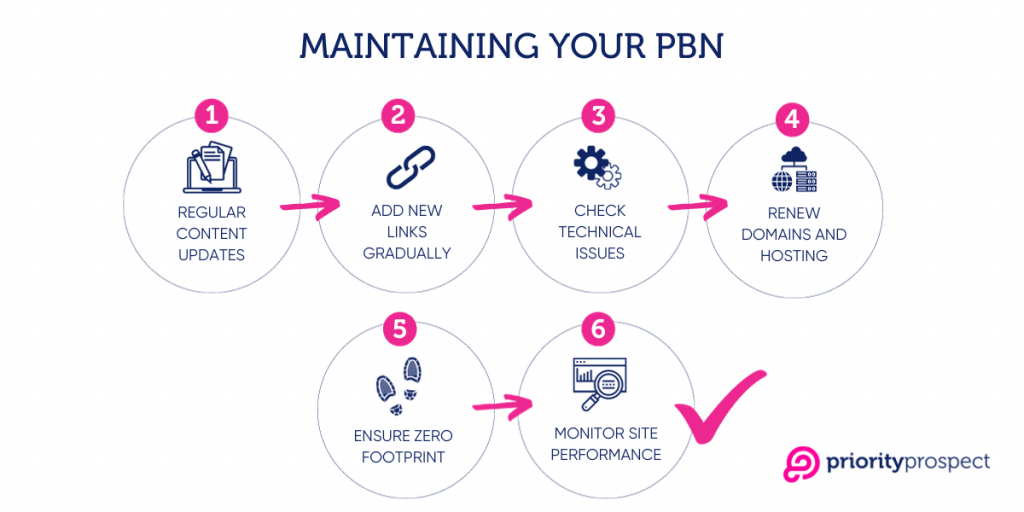
Treat footprint management as an ongoing process, not a one-time setup. Run a footprint audit quarterly. Track key variables for every site in a spreadsheet: IP address, registrar, theme, plugin stack, PBN hosting provider, and analytics setup. If the same value appears across three or more sites, treat it as a risk and fix it. Also, take a look at our article about how to build a natural looking PBN.
Mistake 3: Buying domains without proper vetting
Expired domains are what your PBN is built on, but a bad domain doesn't just fail to help; it can actively harm your money site.
Domains carry their history with them. Previous penalties, spam-heavy backlink profiles, or use in grey-market niches (gambling, pharma, adult) don't disappear after expiry.
The problem isn't just obvious spam. It's also domains with inflated metrics; high DR, no real traffic, or domains that have changed niche so many times that their backlink profile no longer makes sense.
At a minimum, every domain should pass a few basic checks:
Clean history in the Wayback Machine (no spam or unrelated niches)
Consistent backlink profile from real sites (not directories or link farms)
No major traffic drops or unnatural metric spikes in Ahrefs
Indexed in Google with a normal page count
If a domain fails any of these, it's not worth the risk.
For a complete breakdown of how to evaluate expired domains, see our full guides:
A PBN site that hasn't been updated in months, runs an outdated version of WordPress, and has dozens of broken links is doing two things: harming your link equity and making it obvious the site isn't being maintained.
PBN sites don't need constant attention, but they do need to look alive and legit.
At a minimum, every site should:
Publish new content occasionally (even once or twice a month)
Keep WordPress, themes, and plugins updated.
Fix broken links
Stay indexed in Google.
If a site looks abandoned, it becomes a weak link in your network.
Focus on consistency, not perfection. A small, well-maintained network will always outperform a large, forgotten one.
Outdated WordPress installations are also a security risk; compromised sites are quickly flagged and deindexed, taking your links with them.
Mistake 5: Unnatural link-building patterns
Even a well-built PBN can get flagged if the linking pattern itself appears manipulative.
The most common issue isn't the links themselves; it's how they're placed. Using exact-match anchors on every link, always placing links in the first paragraph, or adding links from all sites at the same time, creates footprints that don't exist on real websites.
Focus on making your linking behavior look editorial rather than engineered.
Vary how and where links are placed. Some should appear in the introduction, others in the middle or at the end. Avoid repeating the same structure across every post.
When building homepage links, make them look natural and place them in the content.
Don't build links all at once. Spread them out over time, and across different sites, so growth looks gradual.
Finally, don't always link to the same page. Mix in homepage and blog posts to create a more natural link profile.
Mistake 6: Linking Too Aggressively and Too Directly
A common mistake is linking to the money site from every single article on a PBN site. While it may seem efficient, this approach does not reflect how real websites typically link out. Most sites do not consistently direct users to the same destination across all content, especially when topics vary.
This creates a clear pattern where one site is always the primary target, regardless of context. From a search engine's perspective, this can appear forced rather than editorial.
How to fix it
In most cases, links should be limited and placed more naturally, often from higher-level pages such as the homepage or key hub pages. The rest of the content should stand on its own without constantly funneling to the same site.
Final Thoughts
The thread connecting all six of these mistakes is the same: Your PBN should look boringly legitimate. That's what makes it work.
Every fix in this guide points toward the same goal: building sites that could plausibly exist on their own, with real content, clean infrastructure, natural linking behavior, and enough maintenance to look alive. That's not a high bar, but it does require consistency.
You don't need a perfect network. You need one that doesn't draw attention. Get the fundamentals right, audit it regularly, and the results will follow.
This account is utilized to share insightful content about succeeding and thriving within the SEO industry, with a particular focus on strategies for success with Priority Prospect.
If you've already read our guide on what a PBN is, you know the fundamental principle: a well-built network is significantly harder to detect than a poorly built one. The networks that run into trouble usually share the same story we see all the time. Weak domains, thin content, and neglected sites. Obvious patterns that […]
Most people start a PBN backwards. They find a decent expired domain, buy it, spin up a WordPress install, and then ask themselves what the network is actually supposed to do. That's how you end up with a messy, inconsistent network that underperforms. Not because the domains are bad, but because there was no plan […]
You keep hearing the term PBN or Private Blog Network. Maybe you saw it mentioned in an SEO forum, spotted it in a competitor analysis, or came across it while trying to understand why certain sites rank so well despite thin content and no obvious outreach strategy. In this article, you will learn what a […]